flowers that refuse to die, explained
What the material actually is, why the name does it no favours, and the arithmetic nobody does before buying flowers.
· 4 min read
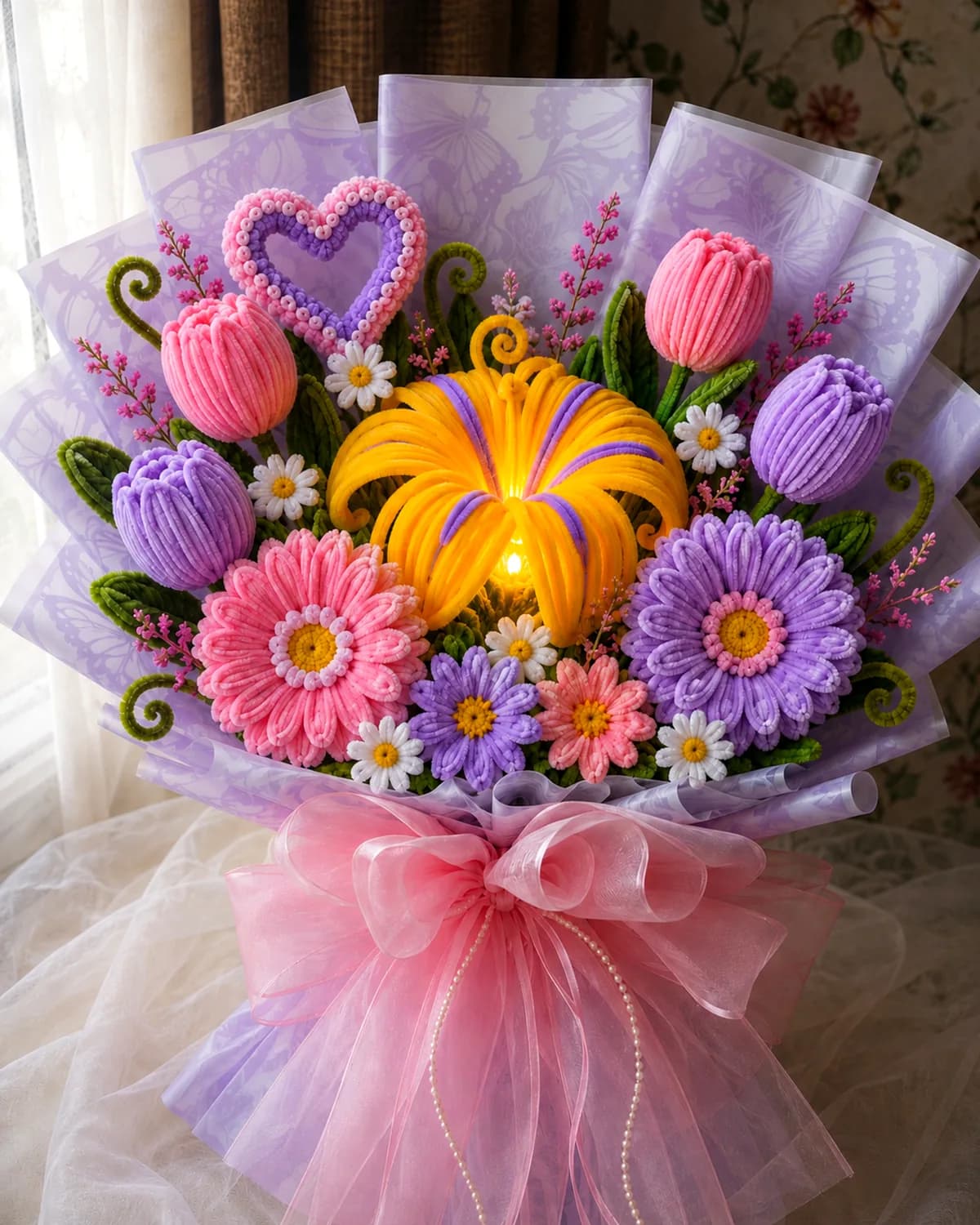
A fresh bouquet lasts four to six days. Then it goes in the bin and you buy another one. A chenille bouquet is still on the table four years later, which is either a good thing or a slightly unnerving one depending on how you feel about permanence.
Chenille flowers are made by hand from chenille wire — a wire core with soft fibre twisted around it. Almost everyone in India knows the material by its other name, pipe cleaners, which does the flowers no favours at all. The word belongs to a craft-supply aisle, and it makes people picture something a seven-year-old brought home from school.
The material is the same. What happens to it is not.
What actually goes into one
Each petal is shaped, curved and set by hand, then bound to a stem, then wrapped. The petals are batched in advance — dozens at a time, colour by colour — and assembled into flowers when an order comes in. That is why a bouquet takes two to three days to make and not two to three hours.
The whole thing, the largest piece we make, is 12+ stems: gerberas, tulips, daisies and a heart, wrapped properly and finished with tulle. It measures about 40 cm across. It is ₹2,999.
That is the price stated once, without apology, and here is the arithmetic behind it.
The maths nobody does before buying flowers
A decent bunch of fresh flowers in Delhi NCR runs ₹600 or so. Say you buy one every couple of months for someone — a birthday, an anniversary, a Tuesday when things were difficult. That is five bunches a year. Three thousand rupees, annually, arriving and dying on a five-day cycle.
The chenille version costs that once.
We are not going to pretend this is why people buy it. Nobody stands in a flower shop running a five-year total cost of ownership. But it is worth saying plainly, because “handmade” and “expensive” travel together in people’s heads and the comparison usually goes unmade.
What they don’t do
They don’t wilt. They don’t drink. They don’t drop petals on a table you then have to wipe. They don’t need a vase, though they look better in one. They don’t smell of anything — this is the one honest disadvantage, and if the smell of fresh flowers is the point for you, buy fresh flowers.
They do get dusty. A hairdryer on cool, from a distance, once a season.
“Chenille” or “pipe cleaner”?
Both. Chenille is the material’s proper name and the one used by everyone selling finished work. Pipe cleaner is what the packet says in a craft shop. If you search for pipe cleaner flowers you will mostly find kits for making them yourself, which is a completely different hobby and a good one.
We make the finished object. In Gurugram, by hand, to order.
What they cost, across the range
The full range runs ₹399 to ₹2,999. A single stem with a card is ₹399. A gift bag of your chosen flowers starts at ₹1,499. The large bouquet above is ₹2,999. Shipping is a flat ₹49 anywhere in India, and everything is made to order, so there are two to three days of making before it ships — one to two days to Delhi NCR after that, three to five days elsewhere.
If you are buying for a date, count backwards from it and add two days. We would rather tell you that now than apologise later.
Made to order in Gurugram. Flat ₹49 shipping anywhere in India. More answers on the questions page.