how a chenille bouquet is actually made
The giant sunflower on the stall table took about 400 pipe cleaners. People did not believe it, which is the entire point of the table.
· 5 min read
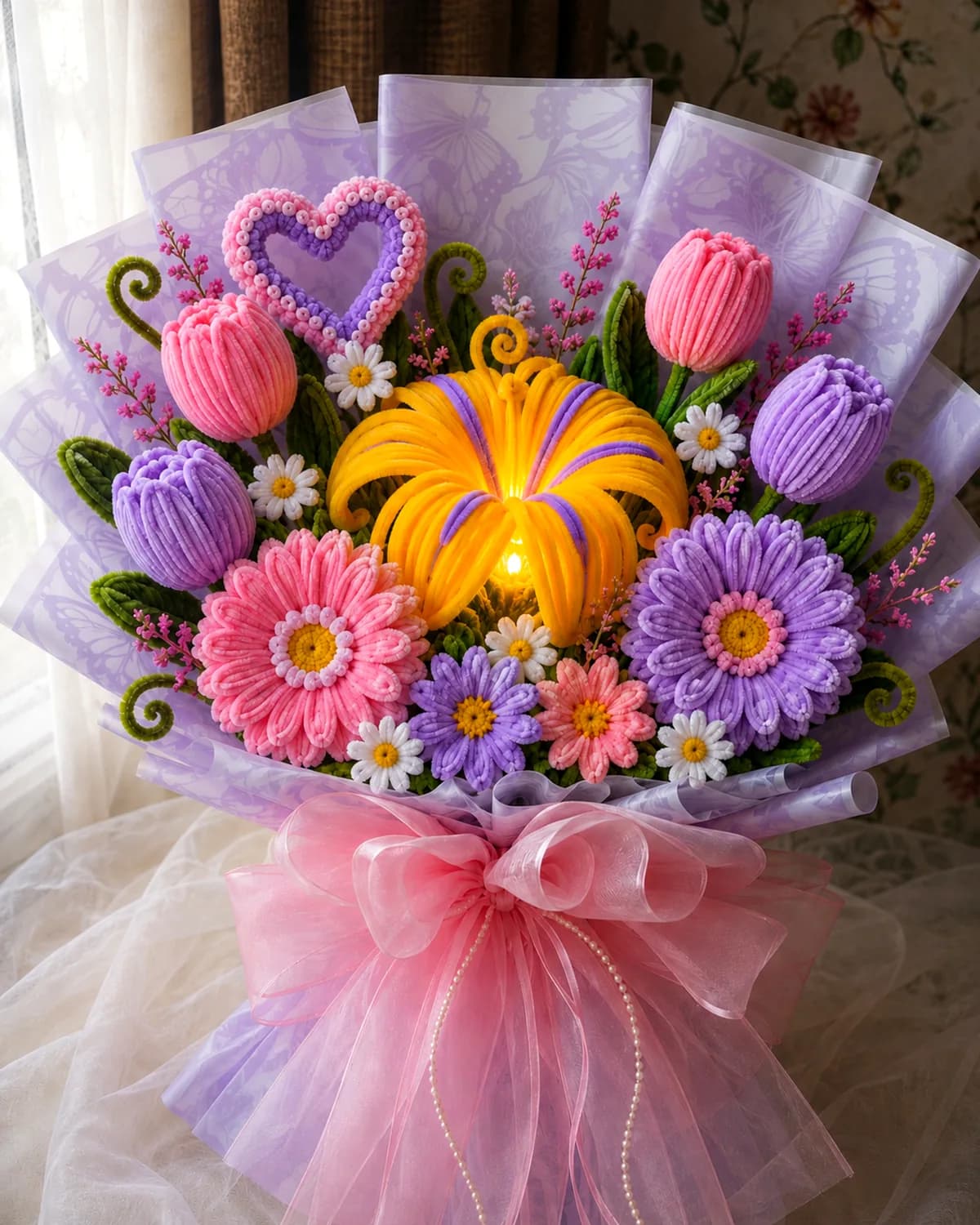
The giant sunflower that sits in the middle of our stall table took about 400 pipe cleaners. People pick it up, turn it over, and say some version of this is not made of that. It is. That disbelief is the reason the table exists.
Here is the whole process, because it is more interesting than the object suggests and because almost nobody who buys one has any idea what they are holding.
1. The material, which has a terrible name
Chenille stems are a steel wire core with polyester pile spun around it. Craft shops call them pipe cleaners, which makes a ₹2,999 bouquet sound like something from under a sink. Chenille is the French word for caterpillar, which is a much better description of what is actually in your hand.
The wire is the entire trick. It means every petal has a skeleton — you can bend it, crush it in a bag, and open it back out, and the flower returns to being the flower. Fabric flowers without a core do not do this. It is also why nothing droops.
2. Petals, in batches
A single petal is a length of stem wrapped around a former — a pen, a dowel, two fingers — then pinched at the base and shaped. One petal takes under a minute once your hands know it.
They are never made one at a time. Forty petals in one colour get made in a run, because switching colours costs more time than the petals do. This is the part that looks least like art and most like a small factory, and it is where the hours go.
3. The centre, and why it is the hard part
A sunflower centre is a tight coil, wound and compressed, and it decides whether the finished flower looks like a sunflower or like a yellow star. Too loose and the flower has no weight in the middle; too tight and the petals splay.
There is no measurement for this. It is judged by hand, and it is the single clearest reason the third flower in a batch is better than the first.
4. Assembly
Petals are twisted onto the centre one at a time, in rings, then the stem is bound and the leaves added. A medium flower is roughly 18–25 stems and takes about half an hour. The large bouquet is 12+ flowers, so:
- Roughly 250–400 stems in one large bouquet.
- About eight to eleven hours of actual hand time.
- Two to three days from order to dispatch, because those hours have to fit around the rest of the day.
5. Why the third one is better
Every batch improves across itself. The first flower is careful and slightly stiff; by the third the hands have found the tension and the petals sit right without being thought about. This is true of every handmade thing and it is why makers do not make one of anything.
It is also why two of ours are never identical. If you get two, hold them side by side — the difference is the evidence.
What this means for what you get
Nothing exists until you order it. There is no warehouse. When you place an order for the large bouquet at ₹2,999, someone starts making petals, and the colours you asked for in the order notes are the colours that get wound.
Made in Sector 45, Gurugram. Flat ₹49 shipping anywhere in India.
Made to order in Gurugram. Flat ₹49 shipping anywhere in India. More answers on the questions page.